


Frustrated at a lack of response from Premier Jiang Yi-huah (江宜樺) over the impending demolition of the homes of four families in Dapu (大埔) in Miaoli County’s Jhunan Township (竹南), dozens of demonstrators yesterday climbed over the gates of the Executive Yuan in Taipei and clashed with police.
Meanwhile, the Presidential Office said later yesterday that Vice President Wu Den-yih (吳敦義) had asked the Miaoli County Government to suspend the planned demolition.
“If the premier is not coming out to see us, we are going in to see him,” Taiwan Rural Front spokeswoman Frida Tsai (蔡培慧) told the crowd, many of whom had been protesting outside the Executive Yuan for two days, as Jiang presided over a Cabinet meeting inside.
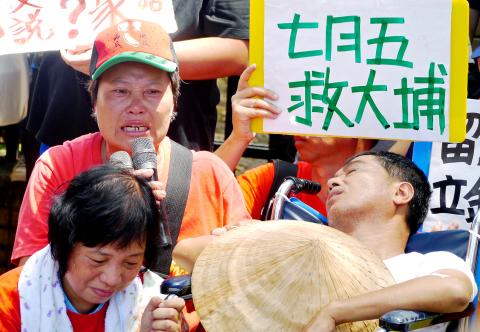
Photo: J. Michael Cole, Taipei Times
As Tsai led the crowd toward the front gate of the Executive Yuan while chanting “Keep your word, save the houses,” dozens of younger protesters quickly pulled out blankets, put them over the fence and climbed over into the Executive Yuan.
Several police officers rushed over to prevent the protesters from going into the Executive Yuan building, while demonstrators on the other side of the fence clashed with officers guarding the front gate.
Emotions were already running high prior to the clashes, especially after Chang Sen-wen (張森文), one of the Dapu residents whose house was scheduled for demolition by the Miaoli County Government any time after today, arrived in a wheelchair.
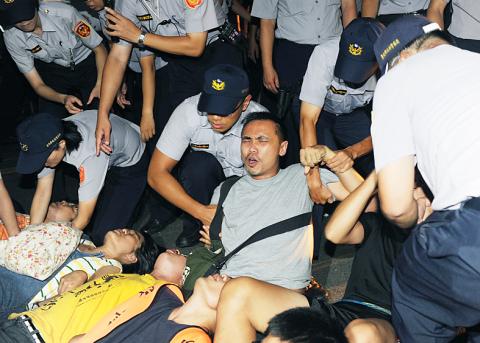
Photo: Lo Pei-der, Taipei Times
Chang lost consciousness early yesterday morning when he was removed by force by the police after two days of camp-in protest in front of the Executive Yuan. He fell unconscious and was still unconscious when he appeared at the demonstration at about 10:30am.
“I insisted on bringing him here, because this may be the last thing he can do for our home before it’s torn down,” Peng Hsiu-chun (彭秀春), Chang’s wife, said in tears. “Please save our home, please save my husband.”
Equally emotional was Chu Ping-kun (朱炳坤), another Dapu resident whose house is also to be demolished.
“My mother committed suicide two years ago because she was so worried about her home and land being taken over by the government. Despite promises by government officials, nothing seems to have changed,” Chu said.
“Seeing what’s happening now to Chang is like seeing what happened to my mother: My mother killed herself, but Chang could be forced into death by the government,” Chu said.
In tears and hardly able to talk, farmer Hung Hsiang (洪箱), from the neighboring township of Houlong (後龍), pleaded for help from the premier.
“I feel sad because I can’t do anything to help when a human life is disappearing in front of me,” Hung said. “A decision that you [the premier] make could save or kill a person. He [Chang] may survive today, but he would eventually die when his house is torn down. Why won’t you help save a life?”
Chang’s condition improved later yesterday afternoon and he returned home as the families and their supporters prepared for a rally in Dapu today.
Twenty-four houses were originally to be flattened to make way for a science park.
However, following fierce protests, the government agreed to allow residents to keep their homes following a negotiation presided over by Wu in 2010 when he was the premier.
However, the decision was overturned by the Ministry of the Interior and, while an administrative lawsuit is ongoing, four of the families received a new demolition order from the county government last month, asking them to tear down their own homes by today.
Meanwhile, the Presidential Office said Wu had called Miaoli County Commissioner Liu Cheng-hung (劉政鴻) yesterday morning and instructed him to suspend the demolition of the four houses scheduled for today, amid intense protests from local residents and their advocates.
Liu said the county government was not planning to demolish the houses today and that the deadline was for the four households to relocate.
He said the county government would handle the case in accordance with the law, and promised to continue to communicate with residents.
The Presidential Office said President Ma Ying-jeou (馬英九) is concerned about the case and expects government agencies to resolve the dispute.
Jiang, who on Wednesday seemed to favor the Miaoli Country Government’s demolition plan, did not comment on the issue at the Cabinet meeting yesterday.
Executive Yuan spokesperson Cheng Li-wun (鄭麗文) said Jiang took the issue very seriously and called on officials at the Ministry of the Interior and the Construction and Planning Agency to brief him about the matter after the Cabinet meeting.
Responding to a reporter’s question, Cheng said it was “too early to tell” whether Wu had broken his promise as the activists alleged.
Wu’s mediation of the case three years ago brought a satisfactory solution to the dispute between the Miaoli County Government and 20 households, Cheng said.
However, regulatory authorities later found it difficult to proceed because the four remaining houses stand in the way of traffic, Cheng said.
Later yesterday afternoon, Jiang said there was still “room for negotiation” to resolve the dispute over how to carry out the road projects involving the four houses, after Wu talked to him and Liu by telephone.
Wu has scheduled a meeting with Liu and him today on the issue, Jiang said, adding that he was hopeful for “better results” after the meeting.
Additional reporting by Shih Hsiu-chuan and Mo Yan-chih

The National Chungshan Institute of Science and Technology yesterday showcased its locally developed variants of the Vision 60 robotic patrol dog, which it plans to deploy on the nation’s outlying territories in the South China Sea. The variants were produced under the Joint Lab project — created by the institute and domestic companies — and assembled with domestically produced motors, lenses and artificial intelligence (AI) systems alongside licensed tech from the US, Missile and Rocket Systems Research Division deputy director Jen Kuo-kang (任國光) told the media event at a military base in Taipei’s Dazhi (大直) area. Taiwan has built up its strengths

RIGHT DIRECTION: Taiwan’s efforts to prevent forced labor include a proposal to ‘fully prohibit’ employers from withholding workers’ documents, an official said Taiwan is to establish a mechanism to restrict imports of goods linked to forced labor, the Executive Yuan said yesterday, after the US proposed imposing additional tariffs on Taiwanese goods over labor concerns. “The Ministry of Labor and the Ministry of Economic Affairs are to establish an interministerial review procedure,” Executive Yuan spokesperson Michelle Lee (李慧芝) said at a news briefing in Taipei. “The government is to use the Foreign Trade Act [貿易法] as the legal basis to restrict imports of goods produced with forced labor” and bring its supply chain governance more in line with international standards on human rights, resilience

NOT IMMEDIATE: Taiwan has a chance to appeal the proposed 10 percent tariff before it starts, while other countries face a 12.5 percent tariff from the trade office Taiwan is among 60 economies determined by the US to have failed to impose or enforce a ban on the importation of goods produced with forced labor, according to a notice released on Tuesday by the Office of the US Trade Representative (USTR), which proposed imposing an additional 10 percent or more tariff on them. The USTR in a statement said that following an investigation, it had determined under Section 301 of the Trade Act of 1974 that the failure of the 60 economies to impose and effectively enforce a prohibition on the importation of goods produced with forced labor is

TIT-FOR-TAT: The US allegedly revoked the visa of a Chinese national working at Xinhua News Agency in the US in response to Beijing’s expulsion of Vivian Wang The Presidential Office yesterday condemned China for expelling a New York Times correspondent from Beijing following the newspaper’s interview with President William Lai (賴清德), saying the move highlighted Beijing’s suppression of press freedom and its threat to international news media. Taiwan has noted a series of recent incidents in which Beijing used similar tactics to “threaten and pressure international media outlets and journalists,” Presidential Office spokeswoman Karen Kuo (郭雅慧) said in a statement. “This concerns not only press freedom and freedom of expression, but also the safety of journalists, and Taiwan and relevant partners are paying close attention to the situation,” she


 RSS
RSS